In this article
Quick answer
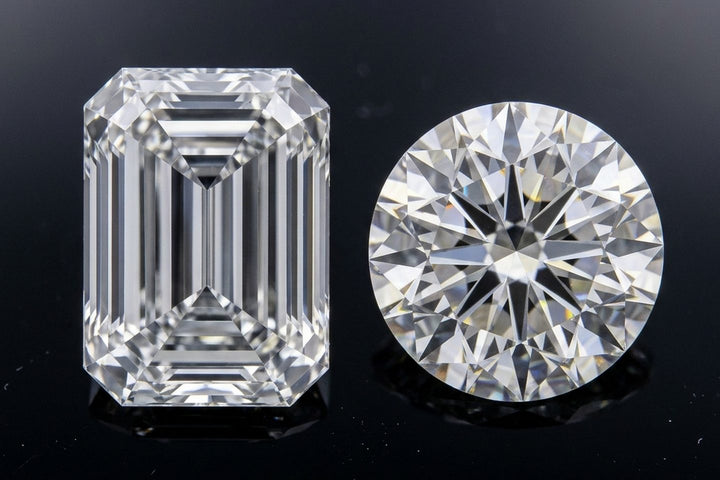
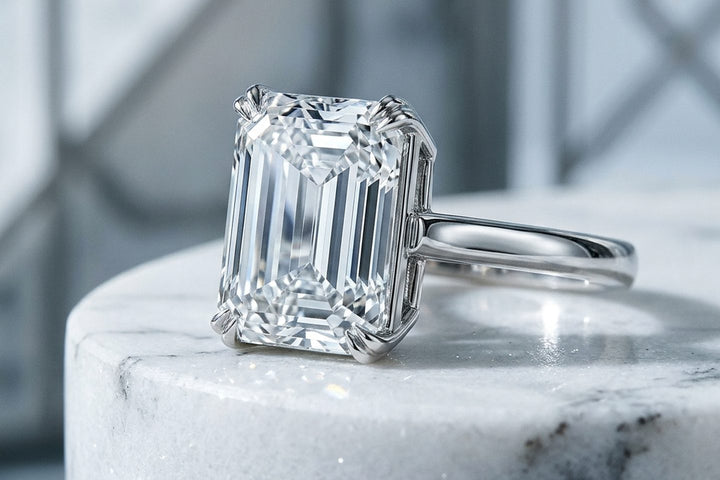
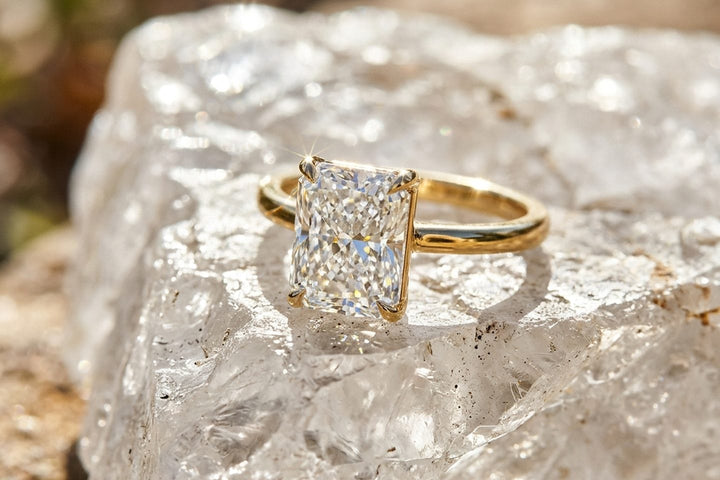
A radiant and an emerald cut share the same rectangular outline with cropped corners, but they look completely different inside. A radiant has many small brilliant facets that scatter light into lively, crushed-ice sparkle. An emerald cut has long parallel step facets that create broad, calm flashes, often called a hall of mirrors. Choose radiant for maximum sparkle and forgiving clarity. Choose emerald for understated elegance, and buy higher clarity, because its open facets show inclusions.
How do they compare?
| Radiant | Emerald | |
|---|---|---|
| Facet style | Brilliant (many small facets) | Step (long parallel facets) |
| Look | Bright, busy sparkle | Clean flashes, glassy depth |
| Shows inclusions | Hides them well | Shows them clearly |
| Shows color | Hides tint fairly well | Shows tint more |
| Size at 1 ct | About 6.5 × 5.5 mm | About 7 × 5 mm |
| Face-up impression | Compact, deep | Broad, flat |
| Style | Modern, glamorous | Vintage, architectural |

Why do they sparkle so differently?
Brilliant facets are angled to split and scatter light into many small points, which the eye reads as sparkle and fire. Step facets are flat and parallel. They reflect light in larger, slower flashes, and between flashes you see into the stone. A radiant is all movement. An emerald is about clarity, symmetry and depth. See step cut vs brilliant cut.
How much does clarity matter for each?
A lot more for an emerald cut. Its open table acts like a window, so an inclusion in the center is easy to see. Many buyers choose VS2 or better for emeralds. A radiant's busy facet pattern camouflages small inclusions, so a lower grade that is clean to the eye is usually fine. See why step cuts need higher clarity and the clarity chart.
Which shows color more?
Emerald. Step cuts let you see the body of the stone, so any tint is visible. Radiants trap and scatter light, which masks tint. This is also why radiants are a favorite for colored diamonds: the same trapping effect deepens a yellow or pink. See the best shapes for fancy color.
Which looks bigger?
The emerald cut usually faces up a little larger because it is shallower, with a broad flat top. A radiant carries more weight in depth. The difference is modest. See which shape looks biggest.
Which ratio should you choose?
- Emerald: about 1.35 to 1.50 for the classic rectangle.
- Radiant: about 1.20 to 1.35 for a rectangle, or 1.00 to 1.05 for a square radiant.
See the ratio guide.
Which settings suit each?
- Emerald: clean solitaires, three stone with tapered baguettes, and Art Deco styles. Four prongs at the corners are standard.
- Radiant: hidden halos, pavé bands and halos that add even more sparkle.
Browse emerald cut rings and radiant cut rings, plus three-stone and hidden halo designs such as the Taperisse baguette three-stone ring. Read the emerald cut guide and the radiant cut guide.
Which should you choose?
| Choose radiant if | Choose emerald if |
|---|---|
| You want the most sparkle in a rectangle | You want a calm, refined look |
| You want clarity to be forgiving | You are happy to buy higher clarity |
| You may choose a colored diamond | You love vintage and Art Deco style |
| You like halos and pavé | You prefer a clean solitaire |
At Diamond Studio the shape does not change the center diamond price. Compare both on any ring page in engagement rings, and see emerald vs asscher for the two step cuts.
Frequently asked questions
What does crushed ice mean in a radiant?
A sparkle pattern of many tiny points, like crushed ice. Some radiants show larger, chunkier flashes. See crushed ice vs chunky facets.
Is an emerald cut dull?
No. It sparkles in broad flashes instead of many points, which many people find more elegant.
Which is more durable?
Both have cropped corners, which protect them well.
Is an emerald cut related to the gemstone?
The cut was developed for emeralds, which are fragile, and later used for diamonds.
How is a radiant different from a cushion?
A radiant has straight sides and cropped corners. A cushion has curved sides and rounded corners.

 IGI certified