In this article
Quick answer
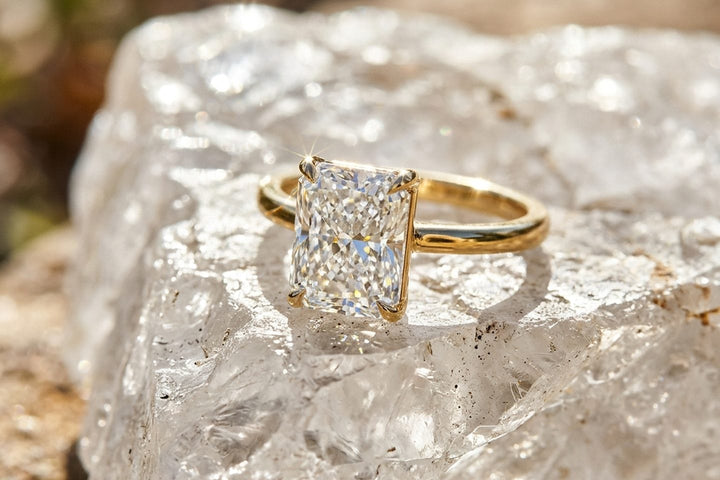
Two radiant diamonds with the same grades can look very different because of how the facets underneath are arranged. A "crushed ice" stone has many small, closely packed facets that break light into countless tiny points, like shaved ice glittering. A "chunky" stone has fewer, larger pavilion facets that return light in bigger, distinct flashes. Neither is a defect. The grading report does not describe this pattern, so you have to judge it from video or in person.
What do crushed ice and chunky mean?
| Crushed ice | Chunky | |
|---|---|---|
| Facet pattern underneath | Many small, irregular reflections | Fewer, larger, defined facets |
| Sparkle | A fine glitter across the whole face | Big flashes with clear dark and light areas |
| Looks like | Crushed or shaved ice | A classic brilliant, closer to a round |
| Shows body color | Can look slightly warmer | Looks crisper and whiter |
| Hides inclusions | Very well | Well |

Why does it happen?
The radiant was designed as a hybrid: a step-cut outline with brilliant-style facets on the underside. Cutters have freedom in how they arrange those lower facets, and in the angles between them. Small changes in angles and the number of pavilion facets change whether reflections break into many small pieces or a few large ones. The rough crystal also matters: cutters choose the pattern that keeps the most weight from each piece.
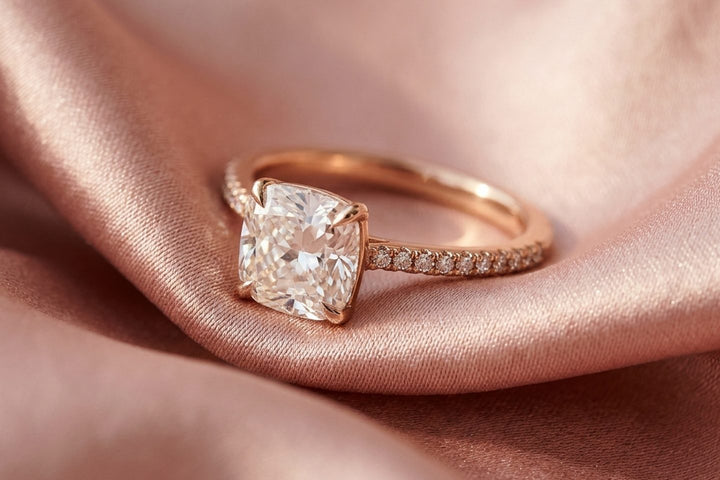
The same variation appears in cushion cuts and, to a lesser degree, in ovals and pears. Cushions in particular are often described as "crushed ice" or "antique" (chunky). See the cushion cut guide.
Which is better?
Neither, by any grading standard. It is a matter of taste:
- Choose crushed ice if you love an all-over glitter and a soft, glamorous look, or for a colored diamond, where the pattern helps hold color.
- Choose chunky if you prefer crisp, bold flashes and a whiter, brighter appearance, or if you want a radiant that reads more like a classic brilliant.
One practical point: very strong crushed ice in a white diamond can make the stone look a touch milkier or warmer, because light is scattered so finely. A moderate pattern avoids that.
How can you tell before buying?
- Ask for video, ideally in daylight and under spotlights. Still photos rarely show the pattern.
- Look at the stone face-up and tilted. Crushed ice twinkles everywhere at once. Chunky stones flash in sections as they move.
- Check the depth. Very deep radiants are more likely to show crushed ice. This is a tendency, not a rule.
- Ask the jeweler directly how they would describe the faceting.
Does the setting change it?
Not the pattern itself, but it changes the overall effect. A hidden halo or pavé band adds small sparkle that complements crushed ice. A clean solitaire lets a chunky stone's large flashes stand out. See hidden halo rings and solitaire rings.
What else should you check in a radiant?
- Ratio: about 1.00 to 1.05 for a square, 1.20 to 1.35 for a rectangle. See the ratio guide.
- Depth: roughly 61 to 69 percent is typical. Very deep stones face up small. See what diamond spread is.
- Corners: even and symmetrical.
- Clarity: clean to the eye is enough, since radiants hide inclusions well.
For a full comparison with neighboring shapes, see radiant vs emerald and radiant vs princess. Browse radiant cut rings and cushion cut rings, or read the radiant cut guide.
Frequently asked questions
Does the grading report say if a radiant is crushed ice?
No. Reports describe grades and measurements, not the visual faceting pattern.
Is crushed ice a sign of a poor cut?
No. It is a style of faceting. Only an extreme version that makes the stone look hazy is a concern.
Do cushion cuts have the same variation?
Yes. Cushions are often sold as crushed ice or as chunky antique-style cuts.
Are lab-grown radiants more likely to be crushed ice?
Not inherently. The pattern depends on the cutter, not on where the diamond grew.
Which pattern suits a colored diamond?
Crushed ice usually, because it keeps light inside longer and deepens color.

 IGI certified