In this article
Quick answer
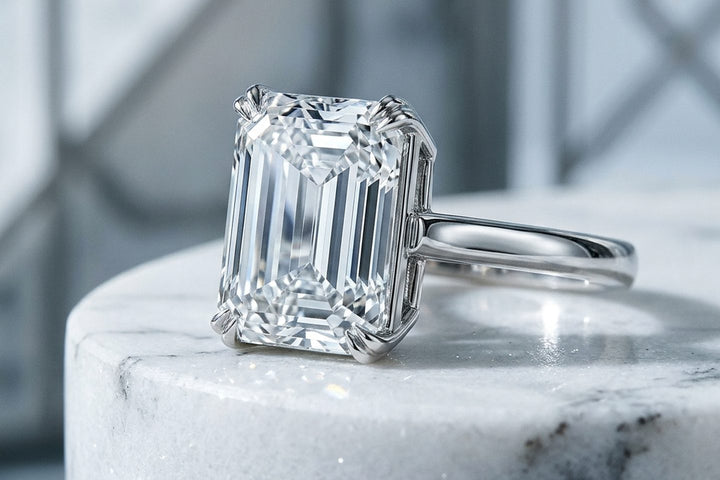
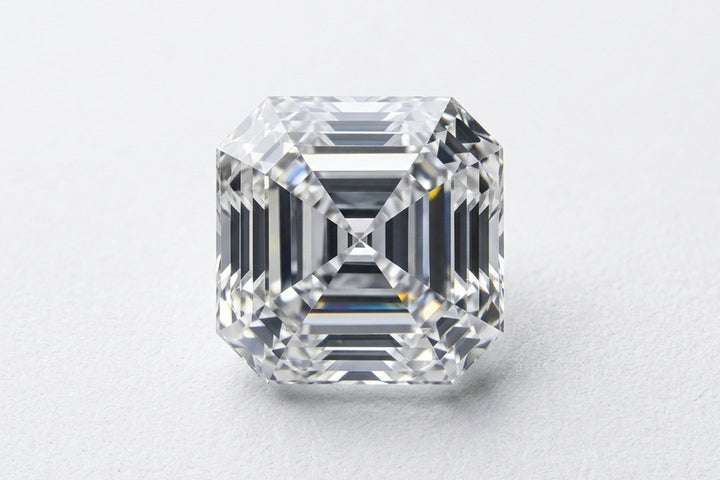
An emerald cut and an asscher cut are both step cuts, with long flat facets arranged like the steps of a staircase. The difference is the outline. An emerald cut is a rectangle, usually about one and a half times as long as it is wide, and shows broad parallel flashes often called a hall of mirrors. An asscher is a square with large cut corners, and its steps converge toward the center in a windmill pattern. The emerald looks larger and more elongated on the finger. The asscher is deeper, more compact and strongly Art Deco.
How do they compare?
| Emerald cut | Asscher cut | |
|---|---|---|
| Outline | Rectangle with cropped corners | Square with large cropped corners |
| Typical ratio | 1.35 to 1.50 | 1.00 to 1.05 |
| Size at 1 ct | About 7 × 5 mm | About 5.5 mm |
| Face-up look | Long panes of light | Concentric squares, a windmill |
| Depth | Moderate | Deep, with a high crown |
| Looks on the finger | Larger, lengthening | Compact, sculptural |
| Era | Classic, timeless | Art Deco, 1920s |

How do they look different?
An emerald cut's long facets run lengthwise, so light flashes across the stone in wide bands. Between flashes you look deep into the diamond. An asscher's steps form a set of squares inside squares, and its high crown and deep pavilion make those squares appear to recede toward a point. When the stone is well cut, the effect is often described as a windmill or a tunnel. It is the more geometric and dramatic of the two.
Do both need high clarity?
Yes. Step cuts have open facets that act as windows, so inclusions near the center are easier to see than in brilliant cuts. For both shapes, most buyers choose VS2 or better, and look at a video of the actual stone. The asscher's depth slightly helps disguise small marks, but the rule is the same. See why step cuts need higher clarity and the clarity chart.
Do they show color?
Both show body color more than brilliant cuts, because there are fewer small facets to scatter light. A faint tint is easier to notice, especially in white metal. Choose color a little higher than you would for a round, or set the stone in yellow gold if you prefer a warmer look. See the diamond color scale guide.
Which looks bigger?
The emerald cut, clearly. It is shallower and longer, so a 1 carat emerald measures about 7 by 5 mm while a 1 carat asscher is about 5.5 mm square. If you love the asscher's look, a halo or a slightly larger stone balances it. See which shape looks biggest.
Which settings suit each?
- Emerald: four-prong solitaires, three stone with tapered baguettes or trapezoids, and east-west settings. See emerald cut rings and the east-west guide.
- Asscher: vintage settings with milgrain and filigree, halos and solitaires set on point for a diamond-shaped outline. See asscher cut rings and vintage-style rings.
Examples that suit step cuts include the Taperisse baguette three-stone ring and the Margot milgrain crossover ring. Read the emerald cut guide and the asscher cut guide.
Are step cuts durable?
Yes. Both have cropped corners, which remove the sharp points that chip in a princess or marquise. Standard four-prong settings protect them well. See which shapes chip most easily.
Which should you choose?
| Choose emerald if | Choose asscher if |
|---|---|
| You want a larger look per carat | You love Art Deco and vintage design |
| You like a long, elegant shape | You prefer a square |
| You want a modern minimalist ring | You want a sculptural, deep stone |
At Diamond Studio the shape does not change the center diamond price. Compare both in engagement rings, and see radiant vs emerald and step cut vs brilliant cut.
Frequently asked questions
Where does the name asscher come from?
From the Asscher family of diamond cutters in Amsterdam, who introduced the cut in 1902.
Is a royal asscher different?
Royal Asscher is a trademarked version with additional facets. Standard asscher cuts follow the same general design.
Does an emerald cut sparkle?
Yes, in broad flashes rather than many small points.
What is a square emerald cut?
Essentially an asscher. Some sellers use the terms loosely.
Why does an asscher look small for its weight?
It has a deep pavilion and high crown, which carry weight below and above the visible outline.

 IGI certified