In this article
Quick answer
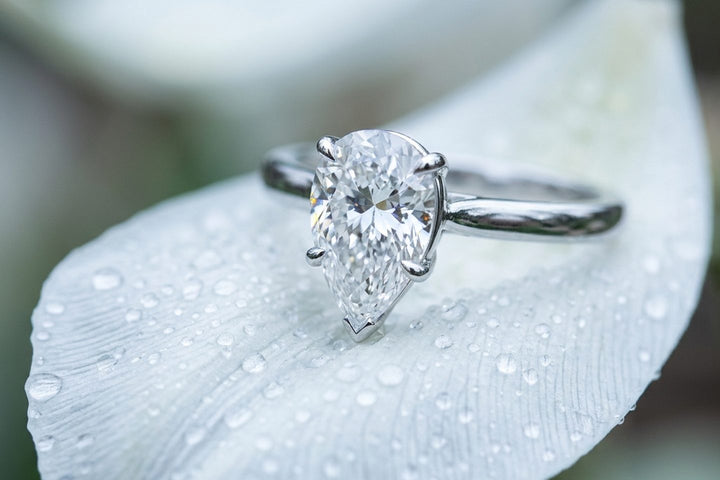
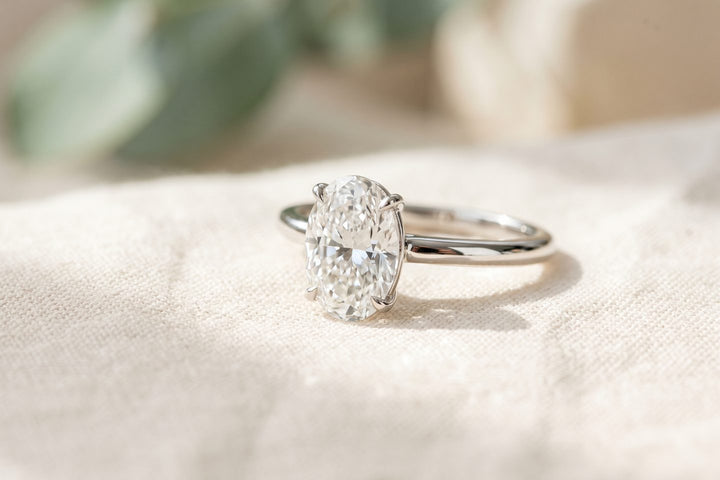
Both are elongated brilliant shapes that look larger than a round of the same weight and lengthen the finger. The difference is the point. An oval is rounded at both ends, symmetrical and easy to wear with any band. A pear is rounded at one end and pointed at the other, which draws the eye along the finger and looks more distinctive and slightly larger, but its point needs protecting. Choose oval for an easy classic and pear for a graceful statement.
How do they compare?
| Oval | Pear | |
|---|---|---|
| Outline | Rounded at both ends | One round end, one point |
| Size at 1 ct | About 7.7 × 5.7 mm | About 8.5 × 5.5 mm |
| Look | Soft, classic | Graceful, dramatic |
| Symmetry check | Easy to see | Critical: shoulders must match |
| Durability | No points | Point needs a V-prong or bezel |
| Bow tie | Possible | Possible |
| Wedding band fit | Straight bands sit well | Often needs a curved or notched band |
How do they look on the hand?
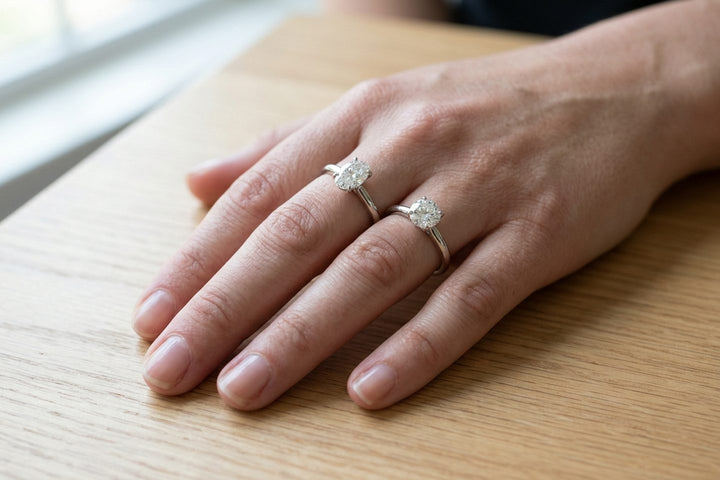
An oval reads as calm and balanced. A pear has direction: the point leads the eye toward the fingertip, which makes the finger look longer still. Because the pear is slightly longer than an oval of the same weight, it also looks a touch larger.

Which way should a pear point?
Traditionally the point faces the fingertip, which lengthens the finger. Some people wear it the other way, point toward the wrist, which is equally valid and reads as more unusual. Decide before the ring is made, because a pear setting is built for one direction.
What should you check in a pear?
- Matching shoulders. The upper curves on each side of the point should be even. Uneven shoulders make the stone look lopsided.
- A centered point lined up with the middle of the rounded end.
- A full rounded end, not flattened.
- A ratio of about 1.50 to 1.70. Lower looks short, higher looks thin.
- A mild bow tie only. See the bow tie guide.
For ovals the main checks are the ratio, about 1.35 to 1.50, and the bow tie. See the ratio guide, the pear guide and the oval guide.
Is a pear more fragile?
Its point is the thinnest part of the stone and the most likely to chip if knocked. A V-shaped prong over the point or a bezel removes most of the risk. An oval has no point, so standard prongs are enough. Both shapes are suitable for daily wear when set properly. See which shapes chip most easily.
Which settings suit each?
| Setting | Oval | Pear |
|---|---|---|
| Solitaire | Classic and clean | Elegant, needs a V-prong |
| Hidden halo | Adds sparkle from the side | Protects the point too |
| Halo | Larger look | Follows the teardrop outline beautifully |
| Three stone | Pear side stones are a favorite | Round side stones balance the point |
| Toi et moi | Pairs with a pear | Pairs with an oval or round |
Browse oval and pear rings. Examples include the Warmpeare pear solitaire and the Veloria hidden halo ring. For two stones together, see the toi et moi guide.
Which wedding bands fit?
A straight band usually sits flush against an oval solitaire. A pear's point often leaves a gap or overlaps a straight band, so a curved, contour or notched band is common. See the wedding band for a pear ring, the wedding band for an oval ring and contour bands.
Which should you choose?
- Choose oval for an easy, versatile ring that pairs with any band and wears without worry.
- Choose pear for a more distinctive, romantic look, and accept a little more care with setting and band.
At Diamond Studio the shape does not change the center diamond price. Compare both on any ring page in engagement rings, and read oval vs round.
Frequently asked questions
Does a pear look bigger than an oval?
Slightly, because it is longer for the same weight.
What does a pear-shaped diamond symbolize?
It is often likened to a teardrop of joy. See diamond shapes and meanings.
Will a pear chip easily?
Only if the point is left exposed. A V-prong or bezel protects it.
Can you combine an oval and a pear?
Yes, in a toi et moi ring or with pear side stones beside an oval center.
Which is more popular?
Oval, by a clear margin. Pear is chosen by people who want something less common.

 IGI certified