In this article
Quick answer
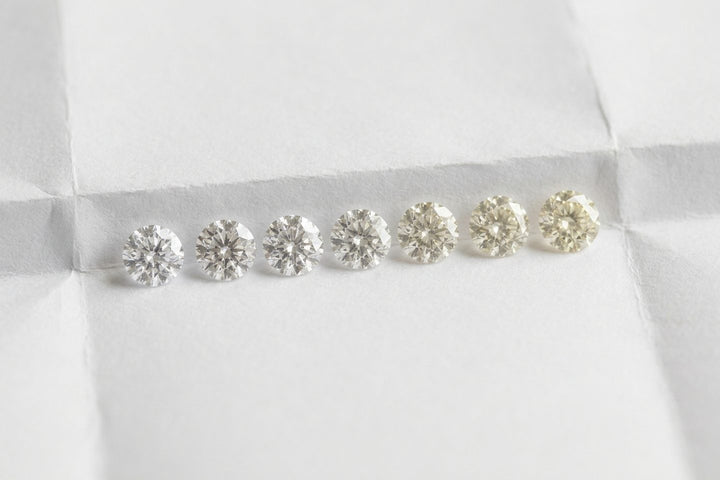
Almost never, once the diamond is set and worn. D, E and F are the three grades in the colorless range, the top of the D to Z scale. Trained graders separate them by comparing loose stones upside down against master stones under controlled light. Face-up in a ring, all three look icy white. The practical differences are price and the satisfaction of owning the top grade. For most buyers E or F looks the same as D for less money.
Where do D, E and F sit on the scale?
| Grade | Category | What a grader sees | What you see in a ring |
|---|---|---|---|
| D | Colorless | Absolutely no color | Icy white |
| E | Colorless | A trace detectable only by an expert | Icy white |
| F | Colorless | A slight trace detectable only by an expert | Icy white |
| G, H | Near colorless | Faint color in comparison | White to most eyes |
| I, J | Near colorless | Slight warmth | White, faint warmth in some light |
The full scale is in the diamond color scale guide.
How do graders tell them apart?
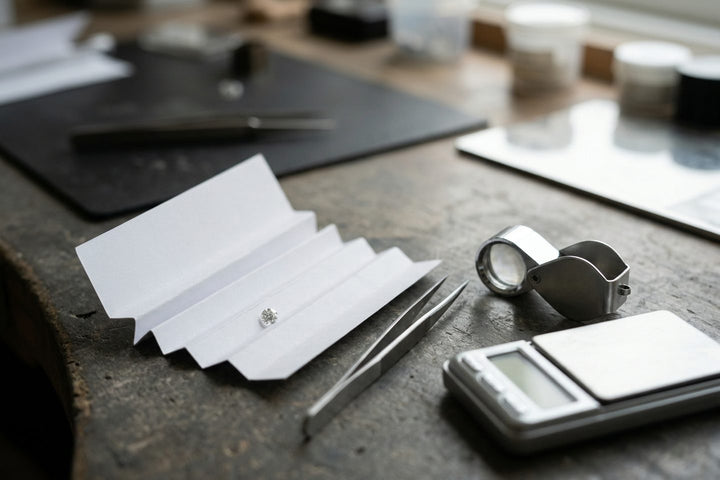
A grader places the diamond table-down on a white surface, so sparkle does not mask color, and compares it side by side with master stones of known grade under standardized daylight. The difference between D, E and F appears as the faintest change in tone looking through the side of the stone.

Why can't you see it in a ring?
- Face-up sparkle hides faint body color.
- The setting reflects its own color into the stone.
- Lighting changes constantly, from daylight to warm bulbs.
- There is no reference stone beside it.
Does the metal matter?
Yes, more than the difference between D and F. In yellow or rose gold, warm metal reflects into the stone, so a near-colorless G or H looks just as white as a D. In white gold or platinum, colorless grades look their crispest. See white vs yellow vs rose gold and does yellow gold make a diamond look yellow.
Do shape and size change it?
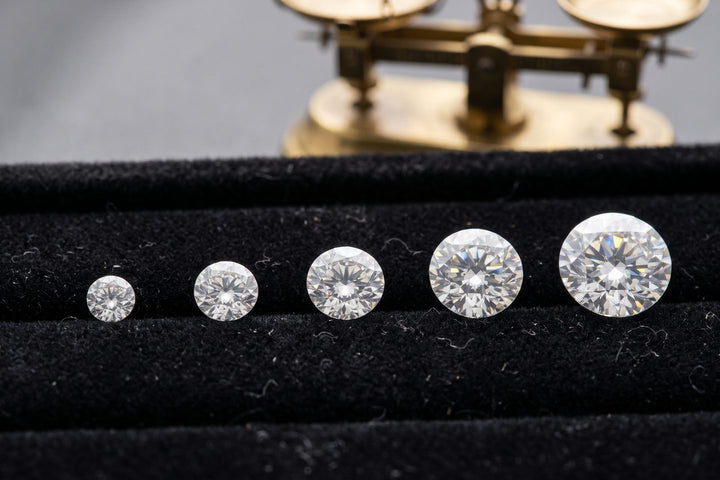
- Larger stones show color more, because light travels further through them.
- Step cuts such as emerald and asscher show body color more than brilliant cuts.
- Elongated shapes can show slight color at the ends.
So for a large emerald cut in platinum, the top colorless grades make a little more sense. For a round in yellow gold they matter least. See radiant vs emerald.
When is paying for D worth it?
- You want the satisfaction of the highest grade.
- The stone is large and set in white metal.
- It is a step cut that shows color.
- With lab-grown diamonds, where the price step from F to D is often small.
How does this work with lab-grown?
Most lab-grown diamonds are produced in the colorless and near-colorless range, so D to F is widely available and the price gap between grades is narrow. At Diamond Studio, lab-grown center diamonds are offered in grade combinations including E/VS1, E/VVS2 and D/VVS2, chosen on the ring page. Browse lab-grown diamond engagement rings and read what an eye-clean diamond is and the 4 Cs.
Frequently asked questions
Is a D color diamond rarer?
Among natural diamonds, yes. Among lab-grown, D is common.
Is G color good enough?
For most rings, yes. It looks white to almost everyone once set.
Does fluorescence affect D to F?
Rarely. Very strong fluorescence can make some stones look slightly hazy in sunlight. See the fluorescence guide.
Why does the scale start at D?
Older systems used A, B and C loosely. GIA started at D to avoid confusion.
Should I spend on color or clarity?
Aim for eye-clean clarity and the color that looks white in your chosen metal, then spend the rest on cut and size.

 IGI certified