In this article
Quick answer
Yes. A lab-grown colored diamond is a real diamond. It is crystallized carbon with the same hardness, density and brilliance as a mined diamond, and it passes a diamond tester. The color comes either from an element added while the crystal grows or from a controlled treatment afterward. Glass, cubic zirconia and colored moissanite are imitations. A lab-grown colored diamond is not.
What makes a diamond "real"?
A diamond is defined by what it is made of and how its atoms are arranged: carbon in a cubic crystal. Where the crystal formed does not change that. In the United States, the Federal Trade Commission's jewelry guides describe a diamond as essentially pure carbon crystallized in the cubic system, and require only that a lab-grown stone is clearly described as laboratory grown.
| Lab-grown colored diamond | Natural colored diamond | Imitation (CZ, glass, moissanite) | |
|---|---|---|---|
| Material | Carbon crystal | Carbon crystal | A different substance |
| Hardness (Mohs) | 10 | 10 | 5.5 to 9.25 |
| Passes a diamond tester | Yes | Yes | No, or only on some testers |
| Graded by gem labs as diamond | Yes, marked laboratory grown | Yes | No |
For the white-diamond version of this question, see are lab-grown diamonds real and do lab-grown diamonds pass a diamond tester.
Where does the color come from?
There are two routes, and both are also found in nature.
- Color grown in. Nitrogen in the growth chamber produces yellow. Boron produces blue. The element becomes part of the crystal from the first layer to the last.
- Color created after growth. Most pinks, and some other colors, are produced by treating a finished crystal with controlled radiation and heat. This shifts atoms inside the crystal so that it absorbs different light. The stone is not coated or dyed. The color runs through it.

More detail is in how colored lab-grown diamonds are made and CVD vs HPHT.
Is treated color still "real" color?
Yes, with one condition: it has to be disclosed. Treatment has been used on natural diamonds for decades and gem labs note it on the report. What matters to you as a buyer is that the color is stable and that the paperwork tells the truth. Color produced this way does not wash off, wear off or fade in sunlight. The guide to post-growth treatments explains the terms you may see.
How can you check that a colored diamond is what the seller says?
- Read the grading report. It should say laboratory-grown diamond, give the color grade (for example Fancy Intense Yellow) and note any treatment. See how to read an IGI certificate.
- Match the inscription. Most graded stones have the report number engraved on the edge by laser. A jeweler can show it to you under magnification. See what a laser inscription is.
- Look up the report number on the laboratory's website.
- Be wary of vague words. "Diamond simulant", "created gem" and "diamond alternative" do not mean diamond.
The IGI vs GIA comparison and the diamond certification guide explain who issues these reports.
Do lab-grown colored diamonds last as long?
Yes. Hardness and resistance to scratching are identical to a natural diamond, and color does not weaken the crystal. A lab-grown colored diamond is suitable for a ring worn every day for a lifetime. The one precaution is heat: tell a jeweler the stone is a treated color before any repair with a torch.
Why do people choose lab-grown colored diamonds?
- Color you can pick. You choose the hue and the strength instead of taking what happens to exist.
- Size. Natural vivid colors above 1 carat are scarce. Lab-grown stones are available well beyond that.
- Cost. Natural pink and blue diamonds are priced as collector's items. Lab-grown ones are priced close to lab-grown white diamonds.
At Diamond Studio, colored center diamonds are lab grown, from 1 to 8 carats: yellow, pink, blue and black. You can also browse all lab-grown diamond engagement rings and lab-created diamond jewelry, or read the lab-grown diamond buying guide.
Frequently asked questions
Can a jeweler tell a lab-grown colored diamond from a natural one?
Not by eye. Gem laboratories identify the origin with specialized instruments, which is why the grading report matters.
Is the color a coating?
No. In a properly graded lab-grown colored diamond the color is inside the crystal. Coated stones exist in the market and a report would describe them as coated.
Do lab-grown colored diamonds hold their value?
Buy one to wear, not as an investment. Resale prices for lab-grown diamonds are low. See do lab-grown diamonds hold resale value.
Is a colored lab-grown diamond the same as colored moissanite?
No. Moissanite is silicon carbide, a different material with different sparkle and hardness. See moissanite vs lab-grown diamond.
Which colors can be grown?
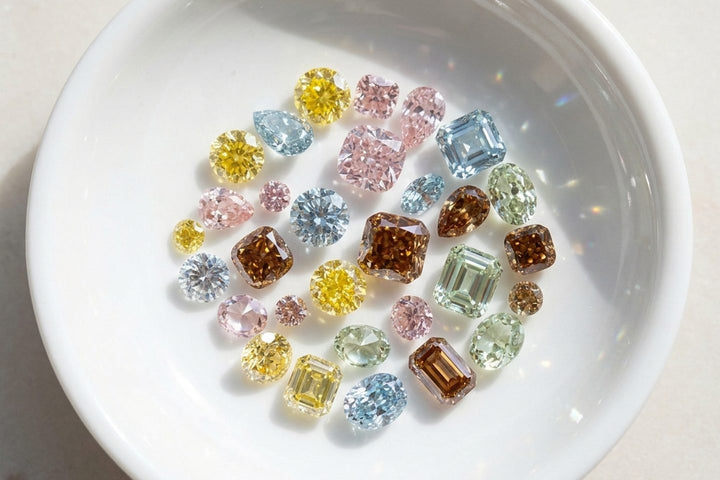
Yellow, pink and blue are the most common, along with black. Green, orange and purple are produced in smaller quantities.

 IGI certified