In this article
Quick answer
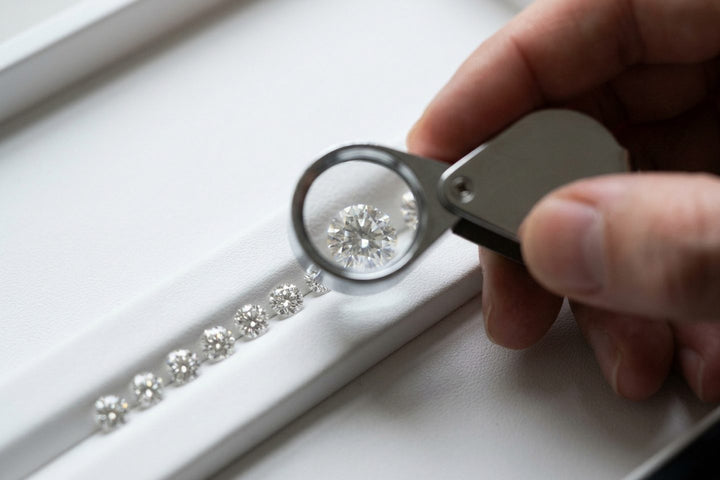
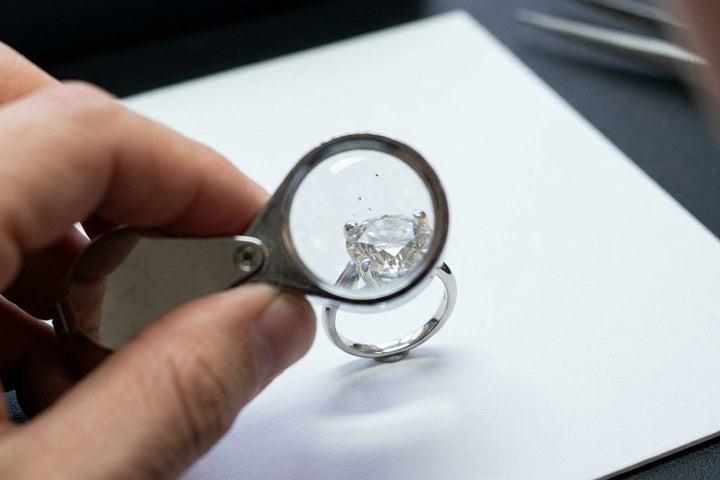
VS means "very slightly included." A VS diamond has small inclusions that a trained grader can see under 10x magnification but that are almost never visible to the naked eye. VS1 inclusions are harder to find than VS2. For most shapes, VS is the sweet spot: the diamond looks clean, and you avoid paying extra for grades you cannot see.
| Grade | Under 10x magnification | To the naked eye |
|---|---|---|
| VVS1 / VVS2 | Extremely difficult to very difficult to see | Clean |
| VS1 | Minor inclusions, difficult to see | Clean |
| VS2 | Minor inclusions, somewhat easy to see | Clean in almost all round and brilliant shapes |
| SI1 / SI2 | Noticeable inclusions | Often clean in SI1; sometimes visible in SI2 |
What VS1 and VS2 mean
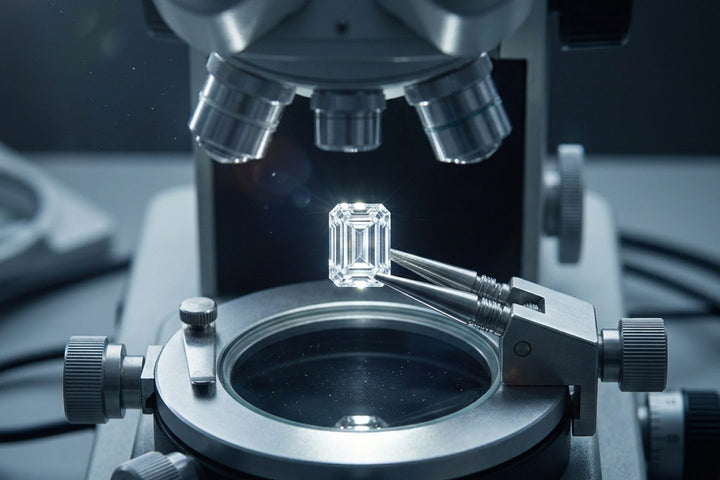
Clarity grades describe the size, number, position and visibility of a diamond's internal characteristics (inclusions) and surface marks (blemishes), judged at 10x magnification by a grading lab such as GIA or IGI. The scale runs from Flawless through IF, VVS1, VVS2, VS1, VS2, SI1, SI2 to I1, I2 and I3. VS sits in the middle of the scale, well above the point where inclusions start to show. See the full scale in our diamond clarity chart.
VS1 diamonds have minor inclusions that are difficult for a grader to find even under magnification. VS2 diamonds have minor inclusions that are somewhat easy to find under magnification. In both, typical inclusions are tiny crystals, small feathers or light clouds.
VS1 vs VS2: which to choose
Face up and without magnification, VS1 and VS2 diamonds look the same. The difference matters most in step cuts. Emerald and Asscher cuts have large open facets that show inclusions more easily, so VS1 is the safer choice there; see why step cuts need higher clarity. In round, oval, cushion, pear, radiant and other brilliant shapes, a VS2 diamond is reliably eye-clean. Where an inclusion sits matters too: one near the edge, hidden by a prong, is less noticeable than one under the table.
VS vs VVS: is the upgrade worth it?
A VVS diamond is rarer, and you pay for that rarity, but it does not look cleaner to the eye than a VS diamond. Both look flawless when worn. That is why many jewelers steer buyers toward VS and put the savings into a better cut or a larger carat. See our VVS clarity guide.
VS vs SI
SI1 diamonds can be eye-clean, but each stone needs to be checked individually, and SI2 inclusions are sometimes visible, especially in larger stones and step cuts. VS is the point where you can stop checking every inclusion and trust the diamond to look clean. See our SI clarity guide.
VS clarity in lab-grown diamonds
Lab-grown diamonds are graded on the same scale. Their inclusions differ slightly: HPHT stones can contain tiny metallic flux, and CVD stones can show small dark carbon points or graining. A VS grade means these are just as minor as in a mined VS diamond. See do lab-grown diamonds have inclusions.
Our standard: VS1 to VS2
Every center diamond Diamond Studio sets is VS1 or VS2 in clarity and D to F in color. It is a deliberate standard: eye-clean, bright white diamonds without the premium for grades no one can see. Browse our engagement rings or read the 4 Cs of diamonds.
Frequently asked questions
Is VS clarity good for an engagement ring?
Yes. VS diamonds are eye-clean in nearly every shape and sit near the top of the clarity scale, so they are one of the best-value choices for an engagement ring.
Can you see inclusions in a VS2 diamond?
Not with the naked eye in brilliant shapes. A grader can see them under 10x magnification. In large emerald or Asscher cuts, choose VS1 to be safe.
Is VS1 or VS2 better value?
VS2 usually offers better value in round and brilliant shapes, since it looks the same as VS1. VS1 is worth it for step cuts and very large stones.
Is VS better than SI?
Yes. VS inclusions are smaller and harder to find than SI inclusions, so VS diamonds are reliably eye-clean while SI diamonds need checking one by one.

 IGI certified