In this article
Quick answer
Not by looking. A lab-grown diamond and a natural diamond of the same grades are identical to the eye and under a jeweler's loupe, and a standard handheld diamond tester reads "diamond" for both. To tell them apart reliably you need specialized instruments that measure how the crystal absorbs and emits light, which gem laboratories and some larger jewelers have. In practice, a jeweler identifies a lab-grown diamond by its laser inscription and grading report.
Why do they look identical?
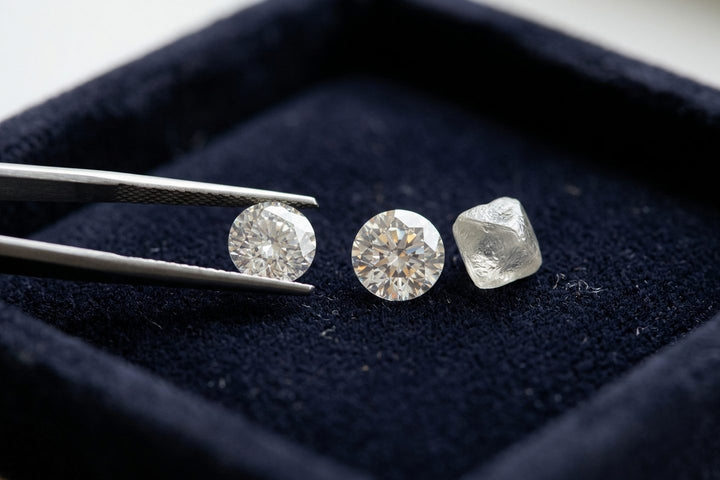
They are the same material: carbon atoms in a diamond crystal, with the same hardness, the same refractive index and the same sparkle. Cut, color and clarity are graded on the same scales. There is no visual tell. See are lab-grown diamonds real.

What can and cannot tell them apart?
| Method | Can it tell? |
|---|---|
| Naked eye | No |
| Jeweler's 10x loupe | No, apart from rare growth features to an expert |
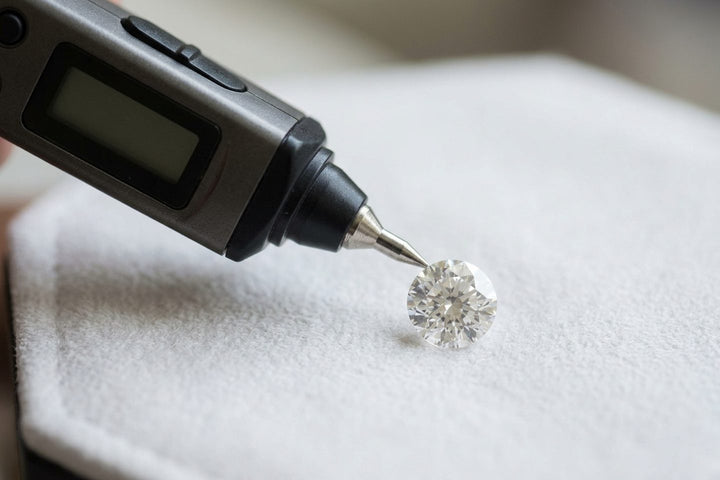
| Thermal or electrical diamond tester | No, both read as diamond |
| Laser inscription and report | Yes, if present and genuine |
| Screening devices (spectroscopy) | Yes, flags stones for further testing |
| Full laboratory analysis | Yes, definitively |
See do lab-grown diamonds pass a diamond tester.
How do laboratories tell?
- Spectroscopy. Natural and lab-grown diamonds often contain different trace elements, such as nitrogen, in different arrangements. Instruments read the light the crystal absorbs.
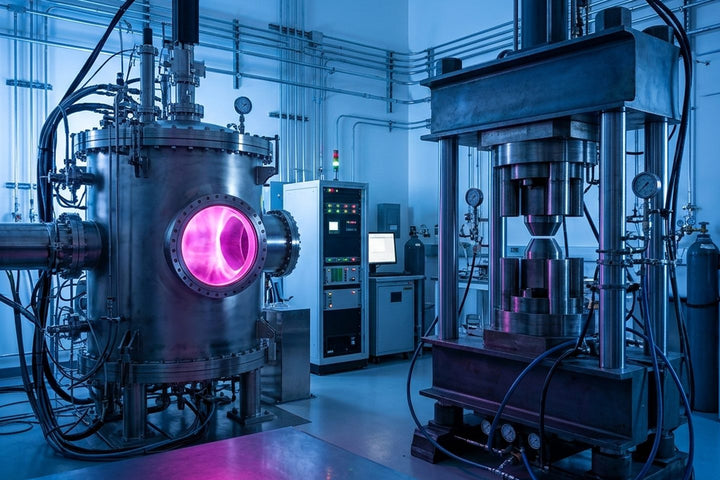
- Fluorescence imaging. Under deep ultraviolet light, growth patterns show up. Natural diamonds grow in octahedral layers; CVD lab diamonds grow in flat layers; HPHT lab diamonds show cube-shaped growth sectors.
- Phosphorescence. Some HPHT lab diamonds glow briefly after ultraviolet light is switched off. See phosphorescence in HPHT diamonds.
- Inclusions. Metallic flux inclusions point to HPHT growth.
See CVD vs HPHT.
How does the inscription help?
Most graded lab-grown diamonds carry a microscopic laser inscription on the girdle, usually the report number and often the words "lab grown". A jeweler can read it with magnification and check the report online. This is the quick, everyday way a lab-grown stone is identified. See what a laser inscription is and how to read an IGI certificate.
Why does identification matter?
- Honest sale. Laws in the United States and elsewhere require lab-grown diamonds to be clearly described as lab grown.
- Value. Natural and lab-grown diamonds are priced very differently, especially at resale.
- Insurance and appraisal. The appraiser needs to know what the stone is. See the appraisal guide.
How do you know what you are buying?
- Buy a center stone with an independent grading report.
- Match the report number to the girdle inscription.
- Look the report up on the laboratory's website.
- Keep the paperwork with your insurance documents.
At Diamond Studio, lab-grown center diamonds come with an IGI report and natural centers with a GIA report. Browse lab-grown diamond engagement rings and all engagement rings, and read lab-grown vs natural diamonds and the IGI vs GIA comparison.
Frequently asked questions
Will friends be able to tell my diamond is lab grown?
No. Nobody can tell by looking.
Do cheap diamond testers detect lab-grown diamonds?
No. Thermal testers only separate diamond from simulants. Some newer devices can screen for lab-grown stones.
Can a laser inscription be removed?
It can be polished off, which is why laboratory testing remains the definitive answer.
Will a jeweler know when I bring my ring in for cleaning?
Only if they read the inscription or test the stone. It makes no difference to care or repair.
Can a vintage diamond be lab grown?
Gem-quality lab-grown diamonds became widely available only in the 2010s, so genuinely old jewelry is natural, unless a stone was replaced.

 IGI certified