In this article
Quick answer
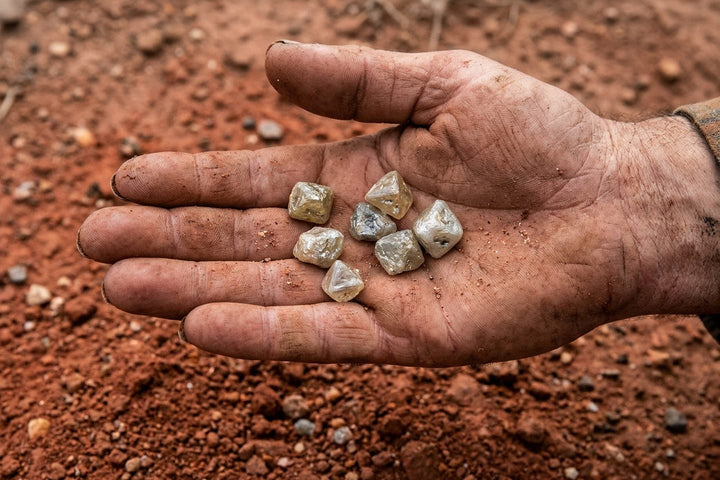
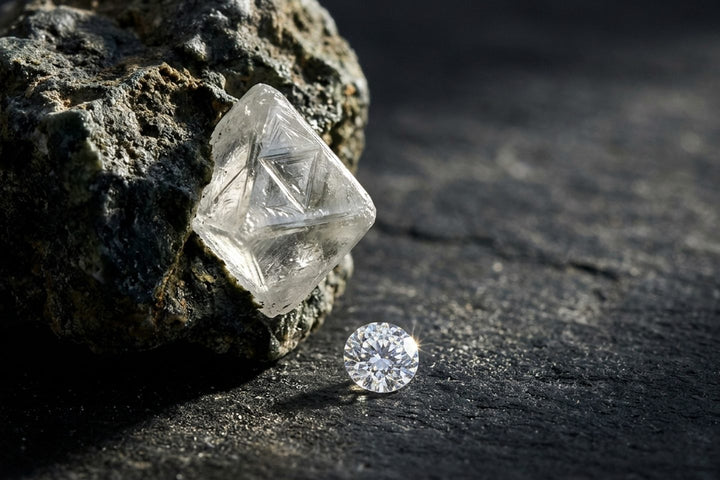
Natural diamonds come from a small number of countries. According to Kimberley Process figures, Russia led global rough diamond production by value in 2025 for the third year running, followed by Botswana, with Angola, Canada, the Democratic Republic of Congo, South Africa and Namibia among the other major sources. Most are mined from volcanic rock called kimberlite, some from riverbeds and the seabed. After mining, the great majority of rough diamonds are cut and polished in India before being set into jewelry around the world.
Which countries produce the most diamonds?
| Country | Character of production |
|---|---|
| Russia | Largest by volume and by value; subject to US, EU and G7 sanctions |
| Botswana | Second by value; high-quality gem production from mines such as Jwaneng and Orapa |
| Angola | A major source by value |
| Canada | Mines in the Northwest Territories; production expected to decline as mines age |
| Democratic Republic of Congo | Very high volume, mostly lower-value and industrial stones |
| South Africa | Historic source, including the Cullinan mine |
| Namibia | Marine diamonds of high average value per carat |
Australia's Argyle mine, once a leading source and famous for pink diamonds, closed in 2020. See what is a pink diamond.
How are diamonds mined?

- Open-pit mining: digging a spiral pit down into a kimberlite pipe.
- Underground mining: tunnels used when the pit becomes too deep.
- Alluvial mining: recovering diamonds carried by rivers into gravel beds, from large operations to small-scale artisanal digging.
- Marine mining: recovering diamonds from the seabed, notably off Namibia.
Tons of rock are processed for each carat recovered. See how diamonds form.
What happens after mining?
- Sorting: rough is sorted by size, color, quality and gem versus industrial use.
- Selling: through producer sales, tenders and auctions.
- Cutting and polishing: mostly in India, especially Surat, with smaller centers in Antwerp, Tel Aviv, New York and elsewhere.
- Grading: at laboratories such as GIA.
- Setting and retail: by jewelers worldwide.
How are conflict diamonds kept out?
The Kimberley Process Certification Scheme, in force since 2003, requires rough diamonds crossing borders to travel in sealed parcels with government certificates. It was designed to stop rough diamonds funding rebel wars. Critics note that its definition does not cover all human rights concerns, which is why some buyers look for additional traceability. See blood diamonds and the ethical diamond guide.
What about Russian diamonds?
The United States, the European Union and other G7 countries have banned imports of Russian diamonds, including Russian diamonds cut in other countries, and have introduced traceability requirements to enforce this. That is one reason origin tracing has become more important. See can you trace where a diamond was mined.
Is there an alternative to mined diamonds?
Lab-grown diamonds are real diamonds grown above ground, with a fully known origin. See how lab-grown diamonds are made and lab-grown vs natural.
At Diamond Studio, natural centers from 1 to 3 carats come with a GIA report and lab-grown centers from 1 to 8 carats with an IGI report. Browse engagement rings and choose natural or lab grown on the ring page.
Frequently asked questions
Which country produces the most valuable diamonds?
Russia leads by total value. Botswana and Namibia are known for a high average value per carat.
Are diamonds mined in the United States?
Very few. Crater of Diamonds State Park in Arkansas lets visitors search, but there is no significant commercial production.
Why does India matter if it does not mine diamonds?
India cuts and polishes the large majority of the world's diamonds.
Why did the Argyle mine close?
It reached the end of its economically viable life in 2020.
Can natural diamonds be ethical?
Yes, especially with documented origin from well-regulated producers. Ask the jeweler what they can show.

 IGI certified