In this article
Quick answer
A colored diamond is graded by looking at it face-up, under controlled lighting, and describing three things: hue (which color it is), tone (how light or dark) and saturation (how strong). The grader combines tone and saturation into one grade word, from Faint up to Fancy Vivid, and adds the hue after it, as in "Fancy Intense Pink". The report also states whether the color is natural, grown in or the result of treatment. Color counts for far more than clarity or cut in a colored diamond.
How is this different from grading a white diamond?
| White diamond | Colored diamond | |
|---|---|---|
| What is rewarded | Absence of color | Presence of color |
| Scale | D to Z letters | Faint to Fancy Vivid |
| How it is viewed | Table-down, from the side | Face-up, as worn |
| Most important factor | Cut, then color and clarity | Color, by a wide margin |
A white diamond is turned upside down for color grading so that sparkle does not distract the eye. A colored diamond is graded the way you will see it in a ring, because the cut is part of what produces its color. For the letter scale, see the diamond color scale guide.
What is hue?
Hue is the basic color: yellow, pink, blue, green, orange and so on. Graders work from a color wheel divided into 27 named hues, which lets them describe in-between colors precisely.
Many diamonds show more than one color. The report then lists a modifier in front of the main hue. The last word is always the dominant color.
- Purplish pink: pink, with a little purple.
- Orangey yellow: yellow, with a little orange.
- Grayish blue: blue, with gray softening it.
- Brown pink (two full words): pink, with a substantial amount of brown.
A single hue with no modifier, such as plain "Blue", is the rarest and most valued.
What is tone?
Tone is how light or dark the color appears, on a range from nearly colorless to nearly black. It has nothing to do with which color it is.

Very light tones read as pastel. Very dark tones can hide the hue, so that a dark blue looks inky. The most attractive stones usually sit in the middle.
What is saturation?
Saturation is the strength or purity of the color. A weakly saturated yellow looks washed out or slightly brownish. A strongly saturated yellow looks like pure, concentrated color. Of the three attributes, saturation has the greatest effect on value.
What are the grade terms?
Tone and saturation together decide which of nine grade words the diamond receives.
| Grade | What it means |
|---|---|
| Faint | Barely perceptible color |
| Very Light | Slight color |
| Light | Noticeable but pale |
| Fancy Light | Clear pastel color |
| Fancy | Obvious, medium color |
| Fancy Intense | Strong, bright color |
| Fancy Vivid | The strongest, purest color |
| Fancy Deep | Strong color, darker tone |
| Fancy Dark | Dark tone, less pure color |
Yellow is a special case. Because white diamonds are already graded for pale yellow on the D to Z scale, a yellow diamond only enters the fancy grades at Fancy Light. The three grades most people shop are explained in Fancy vs Fancy Intense vs Fancy Vivid.
How does a grader arrive at the grade?
- Controlled viewing. The stone sits face-up in a neutral gray viewing box under standardized daylight-equivalent light.
- Comparison. The grader compares it with reference stones and color charts of known grade.
- Characteristic color. A faceted diamond shows a mosaic of lighter and darker patches. The grader judges the overall color the eye settles on, ignoring glare and dark areas.
- Distribution. The report notes whether color is spread evenly or unevenly across the face.
- Origin. Instruments determine whether the color is natural, whether the diamond is laboratory grown, and whether any treatment was used.
- Agreement. More than one grader examines the stone independently before the grade is final.
What will you see on the report?
- Color grade: for example, Fancy Vivid Yellow.
- Color origin: natural, or a statement of treatment.
- Color distribution: even or uneven.
- Identification: natural diamond or laboratory-grown diamond.
- Clarity, carat weight, measurements, polish and symmetry.
Fancy shapes usually receive no overall cut grade. See how to read an IGI certificate, the IGI vs GIA comparison and the diamond certification guide.
Can the cut change the grade?
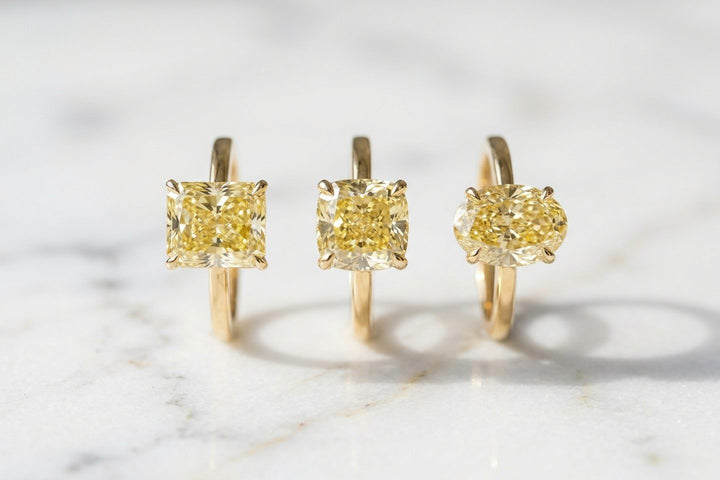
Yes. Because grading is done face-up, a shape that holds color in the stone can earn a stronger grade than the same material cut another way. That is why radiant and cushion cuts dominate colored diamonds. See which shapes show fancy color best.
How should you use the grade when shopping?
- Read the whole phrase. "Fancy Brownish Yellow" and "Fancy Yellow" are different stones.
- Compare like with like: same hue, same grade, same shape.
- Remember that the grade is a range. Two Fancy Intense stones can differ slightly, so look at photos or video.
- Check the origin line so you know what you are paying for.
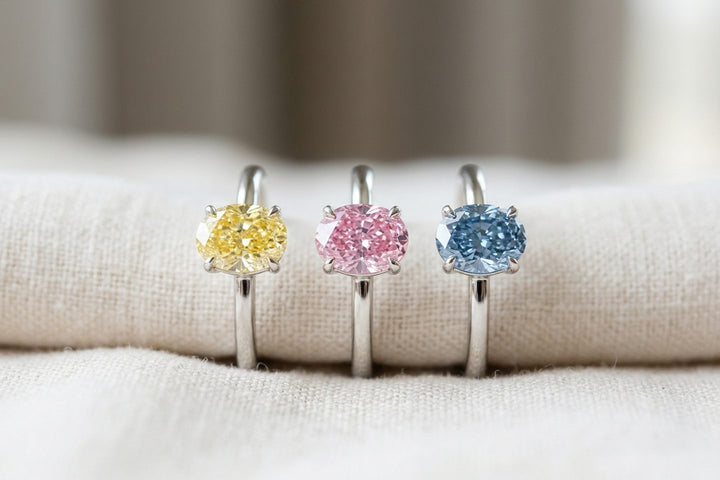
At Diamond Studio, colored center diamonds are lab grown and offered at Fancy, Fancy Intense and Fancy Vivid in yellow, pink and blue, along with black. The fancy colored diamonds guide has more on each color.
Frequently asked questions
Who grades colored diamonds?
Independent gemological laboratories such as GIA and IGI. The seller does not assign the grade.
Are lab-grown colored diamonds graded the same way?
Yes. The same terms are used, and the report states that the diamond is laboratory grown.
Is Fancy Deep better than Fancy Vivid?
No. Fancy Vivid is generally the most valued. Fancy Deep has strong color with a darker tone.
How are black diamonds graded?
They receive one grade, Fancy Black. Tone and saturation steps do not apply to an opaque stone.
Does fluorescence affect the color grade?
It is reported separately. Strong fluorescence can slightly change how some colors look in sunlight. See the fluorescence guide.

 IGI certified