In this article
Quick answer
Four-prong settings are the classic tennis bracelet: each diamond held by four small claws, showing the most stone and the most sparkle. Three-prong settings, often called martini, let the diamonds sit closer together for a fuller, more continuous line, and the stones look slightly larger. Bezel settings wrap each diamond in a smooth rim of metal, which is the most secure and comfortable, at the cost of a little sparkle and a more modern look. For everyday wear, bezel is the safest; for the most sparkle, four prongs.
How do the settings compare?
| Four-prong | Three-prong (martini) | Bezel | |
|---|---|---|---|
| Sparkle | Very high | Very high | High |
| Look | Classic, square links | Fuller, continuous line | Smooth, modern, polka-dot |
| Diamond showing | Most | Most, stones look larger | Less, metal rim visible |
| Snags on clothing | Sometimes | Sometimes | Rarely |
| Security | Good | Good | Highest |
| Upkeep | Check prongs yearly | Check prongs yearly | Minimal |

Why is four-prong the classic?
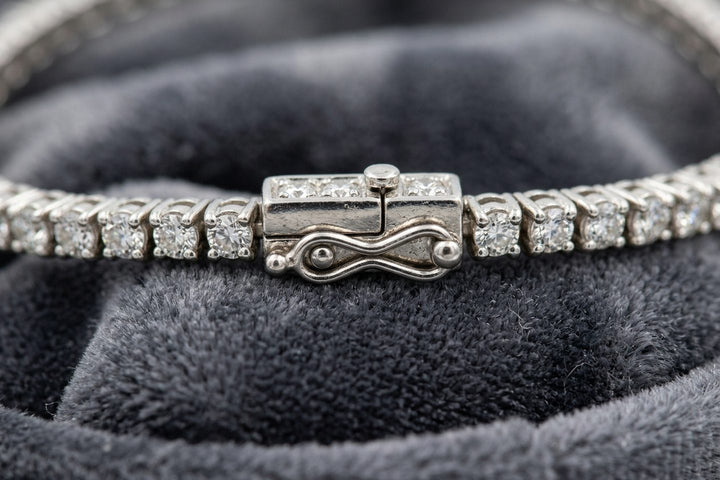
Four claws per stone hold it firmly while covering very little of it, so light can enter from the sides and sparkle is maximized. Each link sits as a small square, which gives the bracelet its tidy, traditional rhythm. The trade-off is that small prongs can catch on knitwear and need checking over time. Examples: the Twinlight round tennis bracelet and the Tristarline round tennis bracelet.
What does a three-prong setting change?
With three prongs, the cups that hold each stone can be shaped as triangles, so the diamonds nestle closer together with less metal between them. The result reads as a single ribbon of light, and each stone looks a little larger. The setting is just as secure for round stones. This style is often called a martini setting after the shape of the cup.
Who should choose a bezel?
- Anyone who wears it every day at a keyboard, in the kitchen or at work.
- Anyone who dislikes snagging on sweaters and silk.
- Anyone who wants the most secure option, since no prong can bend.
The look is more contemporary: a row of polished circles, each framing a diamond. Sparkle is slightly reduced because the edge of each stone is covered.
What about channel and illusion settings?
- Channel: diamonds sit between two continuous metal rails. Very secure and smooth, with a sleek look.
- Illusion: small diamonds sit in reflective metal plates that make them look larger. Common on budget pieces.
Does the clasp matter as much as the setting?
Yes. Most tennis bracelets that are lost slip off at the clasp, not the settings. Choose a box clasp with at least one safety latch, ideally two. See can you wear a tennis bracelet every day and the tennis bracelet buying guide.
Which should you choose?
| If you want | Choose |
|---|---|
| Maximum sparkle, classic look | Four-prong |
| The fullest line of diamonds | Three-prong |
| Everyday comfort and security | Bezel |
| Sleek and very secure | Channel |
For size, see how many carats a tennis bracelet should be and how a tennis bracelet should fit. Browse diamond bracelets, lab-grown diamond bracelets and round diamond bracelets.
Frequently asked questions
Do prong tennis bracelets lose stones?
Rarely, if the prongs are checked about once a year and tightened when needed.
Why is a three-prong setting called martini?
Because the cup that holds the stone is shaped like a martini glass.
Do bezel bracelets look smaller?
The diamonds look slightly smaller because their edges are covered, but the bracelet as a whole looks bolder.
Can a tennis bracelet mix settings?
Yes. Some designs alternate prong-set and bezel-set stones.
Can a tennis bracelet be repaired?
Yes. Prongs can be retipped, links replaced and clasps upgraded.