In this article
Quick answer
Yes, with the right stone and setting. A black diamond is as hard as any other diamond, so it will not scratch in daily wear. The weak point is chipping. Natural and treated black diamonds are full of inclusions, and those can make the edge of the stone more likely to chip from a hard knock. A lab-grown black diamond with a sound crystal, a shape without sharp points and a setting that covers the edge make a black diamond ring fully suitable for every day.
What is the difference between hardness and toughness?
The two words describe different things, and the difference explains everything about black diamonds.
- Hardness is resistance to scratching. Diamond is 10 on the Mohs scale, the top. Keys, sand, countertops and other gems cannot scratch it. Black diamonds share this fully.
- Toughness is resistance to chipping and breaking. Every diamond can chip if it is struck sharply at a thin edge. Toughness depends on how sound the crystal is.
A clear white diamond has few internal flaws, so its toughness is good. A natural black diamond is black because it is packed with tiny inclusions and fractures. Each one is a small point of weakness.
Which kind of black diamond is toughest?
| Type | Internal structure | Chip resistance |
|---|---|---|
| Lab-grown black diamond | A grown crystal, usually more uniform | Best of the three |
| Treated black diamond | Heavily included natural stone, darkened by heat or irradiation | Fair, varies stone to stone |
| Natural black diamond | Dense inclusions and fine fractures | Fair, varies stone to stone |
Whatever the type, look closely at the surface. Small pits, open lines or a rough girdle (the outer edge) are signs of a stone that may chip. A smooth, glossy surface with a clean edge is what you want. The three types are compared in more detail in what is a black diamond.
Which settings protect a black diamond best?
The edge of the stone is where chips start, so the best settings are the ones that cover it.

| Setting | Protection | Notes |
|---|---|---|
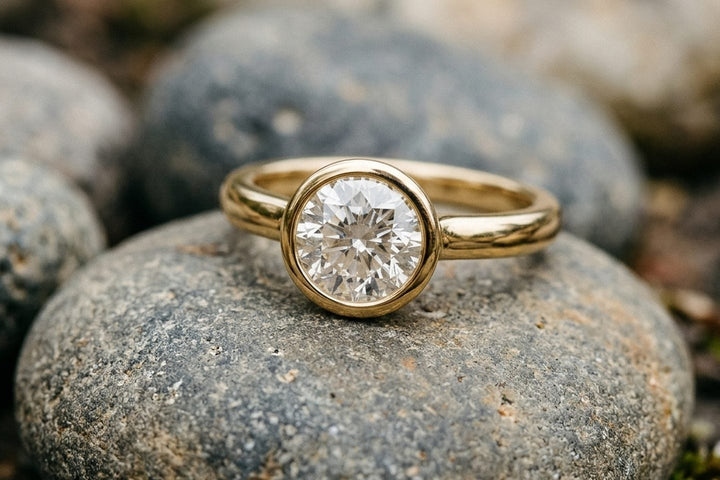
| Full bezel | Highest | Metal surrounds the whole edge. Sits low and smooth. |
| Halo | High | A ring of small diamonds takes the knocks first. |
| Six prongs | Medium to high | More of the edge is covered than with four. |
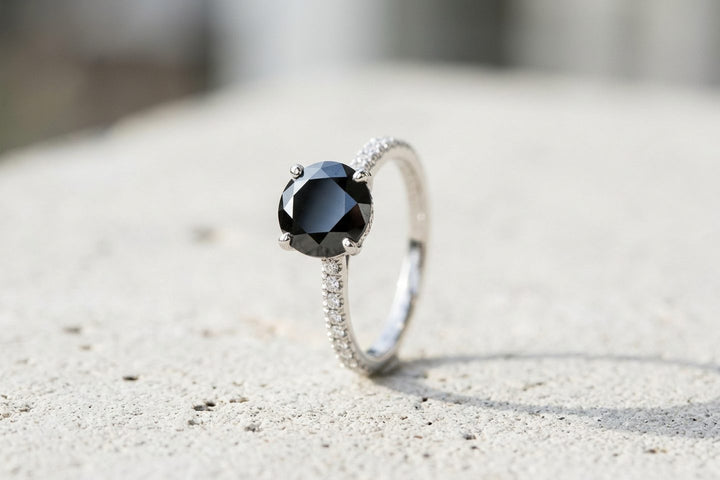
| Four prongs | Medium | Fine for round stones worn with some care. |
| Tension or high cathedral | Lower | Stone sits proud and exposed. |
See the bezel engagement ring guide, halo rings, hidden halo rings and the comparison of high and low profile rings.
Which shapes are safest?
- Best: round, oval and cushion. They have no sharp corners.
- Good with protection: emerald, radiant and asscher, which have cropped corners.
- Need care: pear, marquise, heart and princess. Their points and corners should be covered by a V-shaped prong or a bezel.
Compare round, oval and cushion rings.
What daily habits keep a black diamond ring safe?
- Take it off for impact. Weights, climbing, moving furniture and contact sports are how diamonds of every color get chipped.
- Clean it gently. Warm water, mild soap and a soft brush. Avoid ultrasonic and steam cleaners for natural and treated black diamonds, because vibration and heat can open existing fractures.
- Wipe it often. The appeal of a black diamond is its surface shine, and fingerprints show. A soft cloth restores it in seconds.
- Have the setting checked yearly. A loose stone moves in its seat and is far more likely to chip. See how often jewelry should be inspected.
- Insure it. See the engagement ring insurance guide.
The jewelry care guide covers the full routine.
How does a black diamond compare with other black stones?
| Stone | Hardness (Mohs) | Daily ring wear |
|---|---|---|
| Black diamond | 10 | Very good with a protective setting |
| Black sapphire | 9 | Very good |
| Black spinel | 8 | Good, will scuff over years |
| Black onyx | 6.5 to 7 | Poor, scratches and dulls |
Only the diamond keeps its mirror polish indefinitely, which matters more for a black stone than for any other, since polish is all it has to show.
What should you ask before buying?
- Is the stone natural, treated or lab grown?
- Is the surface free of pits and open fractures?
- Does the setting cover the edge and any points?
At Diamond Studio, black center diamonds are lab grown and available from 1 to 8 carats. Browse black diamond engagement rings, see the Melina hidden halo pavé ring in black, or look at solitaire and vintage-style settings.
Frequently asked questions
Can a black diamond scratch?
Only another diamond can scratch it. Store it apart from other diamond jewelry.
Can a chipped black diamond be repaired?
A small chip can sometimes be polished away or hidden under a prong. A large chip usually means replacing the stone.
Will heat crack a black diamond?
Normal heat will not. The torch used in ring repairs can damage a heavily included or treated stone, so tell the jeweler what the stone is.
Are black diamonds a good choice for men's rings?
Yes. They are often flush set into a band, which is one of the most protective settings there is. See men's wedding bands.
Does a black diamond lose its shine over time?
No. It only looks dull when it is dirty. Cleaning brings the gloss back.

 IGI certified